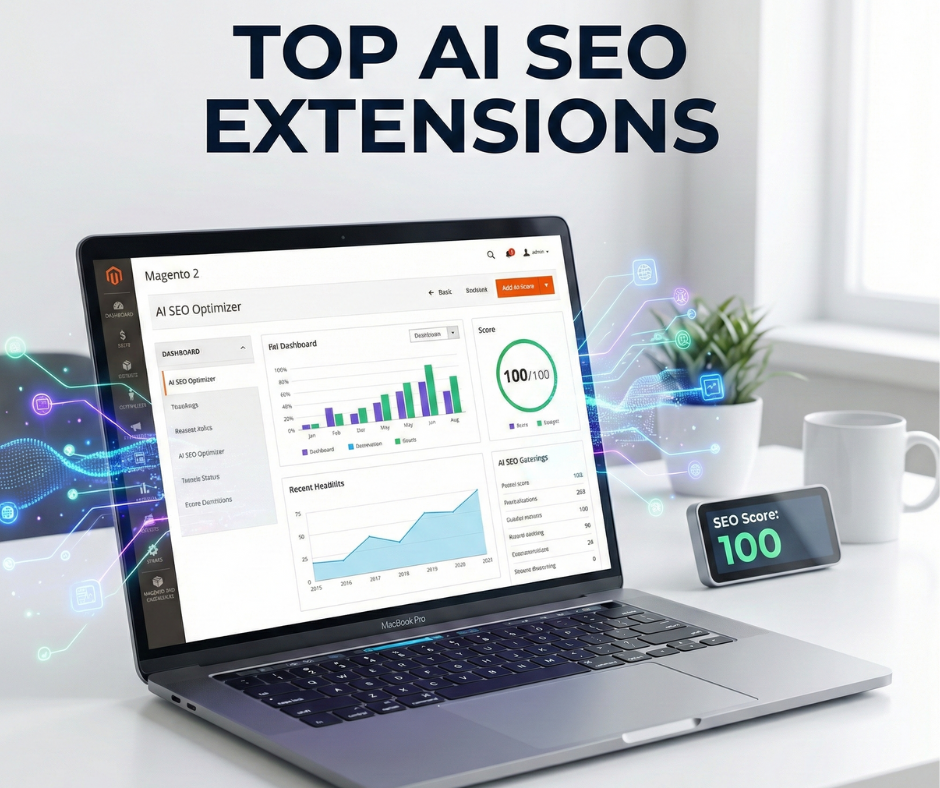
Common SEO challenges in the Magento ecosystem include managing crawl budget, eliminating duplicate content, and ensuring that every product page has unique, high-quality metadata. At scale, these tasks become nearly impossible for human teams to handle without significant delays. This is where AI-powered extensions come into play. By leveraging machine learning, natural language processing (NLP), and large language models (LLMs), these tools can automate the most tedious aspects of SEO while improving the accuracy and relevance of the output.
This article covers the top Magento 2 AI extensions for better SEO designed to automate and improve SEO performance. Whether you are a merchant looking to reduce manual workload, an SEO specialist aiming for more granular control, or an eCommerce manager tasked with scaling organic revenue, this guide will help you identify the right AI-driven solutions for your tech stack.
Nội dung bài viết
- 1 Why use AI extensions for Magento 2 SEO?
- 2 What to look for in a Magento 2 AI SEO extension
- 3 Top Magento 2 AI extensions for better SEO performance
- 4 How these AI extensions improve SEO performance in practice
- 5 How to choose the right AI SEO extension for your Magento store
- 6 Future of AI-driven SEO in Magento 2
- 7 Final thoughts
Why use AI extensions for Magento 2 SEO?

Why use AI extensions for Magento 2 SEO
While traditional Magento SEO extensions provide the necessary infrastructure for technical SEO—such as managing canonical tags, sitemaps, and robots.txt—they often rely on rigid, rule-based templates. For example, a standard extension might use a template like [Product Name] – [Category Name] – [Store Name] for meta titles. While functional, these templates often result in repetitive, uninspired metadata that fails to capture the unique nuances of a product or the specific intent of a searcher.
AI-powered extensions improve upon this in several critical ways:
- Metadata generation at scale: AI can analyze the actual content of a product page, including its description and attributes, to generate unique, keyword-rich meta titles and descriptions that read naturally. This significantly reduces the risk of “duplicate metadata” warnings in Google Search Console.
- Content optimization: Generative AI can assist in writing or refining product descriptions. Instead of using manufacturer-provided descriptions that appear on hundreds of other retail sites, AI can rewrite these descriptions to be unique to your brand, improving your topical authority.
- Search relevance and engagement signals: AI can optimize internal search results and related product blocks. By improving the user’s path to the right product, AI indirectly boosts SEO signals like dwell time and click-through rate (CTR), which are increasingly important for rankings.
The fundamental difference between “AI-powered” and rule-based tools is adaptability. Rule-based tools do exactly what you tell them, even if the result is suboptimal for a specific SKU. AI-powered tools evaluate the context of the data and adjust the output to maximize relevance and performance.
What to look for in a Magento 2 AI SEO extension
Not all extensions claiming to use “AI” are created equal. Some are merely basic automation scripts rebranded for marketing purposes. To ensure you are investing in a tool that will actually improve your SEO performance, consider the following factors:
- True AI capabilities vs basic automation: Does the extension integrate with established LLMs like OpenAI’s GPT-4, Google’s Gemini, or proprietary machine learning models? Look for features that involve natural language generation and data-driven predictions rather than simple “search and replace” logic.
- Magento 2 compatibility and performance impact: Magento 2 is already a resource-heavy platform. An AI extension should ideally handle heavy processing via API calls or asynchronous tasks to avoid slowing down the admin panel or the storefront during bulk operations.
- Bulk SEO management features: The primary value of AI is scale. The extension should allow you to process thousands of products or categories in a single batch, with the ability to review and approve changes before they go live.
- Integration across page types: A robust extension shouldn’t be limited to product pages. It should also support category pages, CMS pages, and even blog posts if your store utilizes a built-in blog module.
- Pricing and scalability: Many AI tools charge based on API usage or the number of words generated. Ensure the pricing model aligns with your catalog size and the frequency of your updates.
Top Magento 2 AI extensions for better SEO performance
The following categories represent the current state of the art for AI-driven SEO within the Magento 2 ecosystem. For merchants specifically interested in integrating the power of Large Language Models, checking out TOP Magento 2 AI extensions that focus on ChatGPT integration is a great starting point for content automation.
AI SEO optimizer and meta generator
This category focuses on solving the “template fatigue” often found in large Magento stores. Instead of generating identical strings for thousands of products, these extensions use Large Language Models (LLMs) to understand the semantic context of a product. They evaluate attributes such as material, color, use-case, and brand to craft unique, compelling meta tags that improve organic click-through rates.
Key features:
- Bulk metadata generation: Ability to generate unique meta titles and descriptions for thousands of SKUs in minutes rather than weeks.
- Contextual keyword injection: Intelligently places primary and secondary keywords based on search intent rather than fixed positions.
- Dynamic tone-of-voice control: Allows merchants to specify if the generated tags should be professional, urgent, or friendly to match the brand identity.
- Multi-language support: Automatically adapts SEO metadata for different store views (e.g., French, German) while maintaining cultural relevance.
Best use cases: Large catalogs where manual entry is impossible, or stores that frequently add new products and need them indexed quickly with unique signals.
Ideal store types: Fashion, electronics, and home goods retailers where product variety is high but product descriptions are often similar.
AI content generation extensions
AI content generation extensions
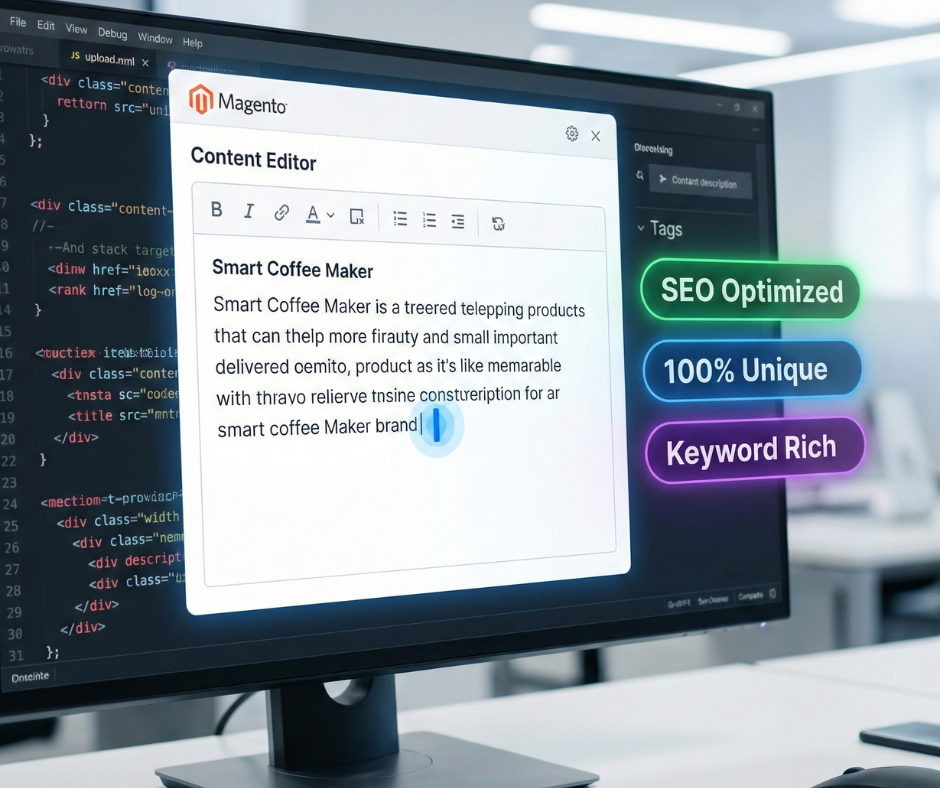
These extensions address the critical problem of thin or duplicate content on product and category pages. By connecting to AI engines, they can take basic product specs and expand them into persuasive, SEO-optimized copy. This is particularly effective for replacing low-quality manufacturer descriptions that can trigger search engine duplicate content penalties.
Key features:
- Automated product descriptions: Generates unique, high-quality product copy based on a few provided attributes or bullet points.
- Category content creation: Crafts unique introductory text for category landing pages to improve topical authority and internal linking.
- Human-in-the-loop workflow: Includes a review dashboard where editors can approve or refine AI-generated content before it goes live.
- Plagiarism check integration: Some advanced tools include built-in checks to ensure the generated content is unique across the web.
SEO benefits and risks: The primary benefit is the elimination of duplicate content. The risk involves “AI-sounding” text that might not resonate with your brand voice. It is essential to use tools that allow for custom prompts to maintain a consistent style.
Content quality control: Most high-end content extensions include a “Review” stage where a human editor can tweak the AI-generated text before publishing, ensuring that factual accuracy remains high.
AI search and product discovery extensions

AI search and product discovery extensions
While primarily considered a user experience (UX) enhancement, AI-powered search has profound implications for technical SEO. Focusing on Magento SEO for ChatGPT and other conversational engines ensures that your site’s content is structured correctly for the next generation of AI-driven discovery. By reducing “zero results” pages and improving navigation efficiency, these tools signal to search engines that your site is a high-authority, high-relevance destination.
Key features:
- Semantic search processing: Understands intent and synonyms (e.g., recognizing that “autumn outerwear” relates to “fall jackets”) even if those exact keywords aren’t on the product page.
- Personalized search results: Dynamically reorders search results based on a user’s previous behavior, increasing dwell time and engagement signals.
- Visual search integration: Allows users to find products via images, creating new types of searchable data points.
- Advanced analytics: Provides “Search Query Reports” that identify high-demand terms that currently return no results, informing future category and content strategies.
Indirect SEO impact: Higher engagement rates tell search engines that your site is a valuable destination for specific queries. Furthermore, these tools can provide data on “no result” searches, allowing SEO teams to create new category pages to fill those gaps.
Best scenarios: Stores with complex catalogs or technical products where users often search by attribute, part number, or specific use cases.
AI-driven schema and structured data tools
Rich snippets are vital for standing out in the search engine results pages (SERPs). AI-driven schema tools automate the mapping of complex Magento data to the correct Schema.org types, ensuring that Google can display price, availability, rating, and even product dimensions directly in the search results.
Key features:
- Automated attribute mapping: Automatically identifies which product attributes correspond to specific schema fields (e.g., mapping “weight_kg” to the “weight” schema property).
- Dynamic JSON-LD generation: Injects real-time structured data that updates as prices or stock levels change, preventing “mismatched data” errors.
- Aggregate rating automation: Intelligently pulls and formats review data from third-party platforms into search-friendly snippets.
- Breadcrumb and FAQ schema: Automatically generates markup for navigation paths and common questions, increasing the visual real estate of your search listing.
Impact on CTR: By ensuring that structured data is always accurate and complete, these tools increase the visual real estate your store occupies in search results, often leading to a significant lift in organic traffic even if your rank stays the same.
AI SEO analytics and insights tools
These extensions function as an “automated SEO auditor.” Instead of providing a static list of errors, they use machine learning to predict which changes will result in the greatest ranking increases. They help eCommerce teams prioritize their limited time on the tasks that will drive the most revenue.
Key features:
- Keyword difficulty prediction: Uses historical data to predict how likely your store is to rank for a specific new term based on your current authority.
- Anomaly detection: Alerts the team if a specific category or product suddenly drops in impressions or rankings, allowing for immediate technical triage.
- Automated task auditing: Scans the site for technical debt (e.g., broken redirects, duplicate H1s) and assigns priority scores based on potential SEO impact.
- Competitor benchmarking: Analyzes competitor performance in real-time to suggest where your store has “content gaps” that could be exploited.
Task prioritization: Instead of a generic checklist, AI helps you prioritize tasks that will deliver the highest ROI, such as “Optimize the 50 product pages that have high impressions but low click-through rates.”
How these AI extensions improve SEO performance in practice
Implementing AI in your Magento store isn’t just about the technology; it’s about the efficiency gains. In practice, the top Magento 2 AI extensions for better SEO solve the “bottleneck” problem of human creativity and speed.
For a store with 50,000 products, manually writing unique meta descriptions for every item would take a team of writers months. An AI extension can complete this task in a few hours. This speed allows for bulk optimization, where you can update your entire catalog in response to a new marketing trend or a search engine algorithm change almost instantly.
Furthermore, AI improves content consistency. Unlike human writers who might use different formatting or styles over time, an AI can be prompted to follow a strict brand guideline across every single page. This creates a more professional, cohesive user experience that builds trust with both users and search engines.
How to choose the right AI SEO extension for your Magento store
Choosing the right tool requires a clear understanding of your current SEO maturity and business goals.
- Store size and product count: If you have under 100 products, the cost and setup time of an AI extension might not be justified. For stores with over 1,000 SKUs, AI becomes a necessity for maintaining a competitive edge.
- Budget and technical resources: Consider the total cost of ownership. Some extensions have low upfront costs but high recurring API fees. Ensure you have the technical capacity to integrate the API keys and monitor the output.
- Single extension vs combining tools: You don’t necessarily need an “all-in-one” AI extension. Many merchants find success by using a dedicated technical SEO extension (for sitemaps and canonicals) and adding a specialized AI content generator on top.
When is AI not enough? AI extensions are tools, not a replacement for an SEO strategy. They cannot decide which new markets you should enter or how you should position your brand against a specific competitor. Human oversight is always required to ensure the AI’s “creativity” doesn’t lead to factual errors about your products.
Future of AI-driven SEO in Magento 2
The future of Magento SEO is increasingly generative and personalized. Keeping pace with the emerging Magento SEO trends in 2026 will be essential for merchants who want to maintain visibility as search engines like Google incorporate more AI into their core algorithms. We are moving toward a world where the content on a Magento page might be dynamically generated or altered in real-time to match the specific intent of the searcher.
Preparing your Magento store for this “AI-first” world involves ensuring your data is clean. AI thrives on high-quality input. If your product attributes are well-structured and your database is free of bloat, any AI extension you install will perform significantly better. As search engines like Google incorporate more AI into their own ranking systems (SGE), having a site that is structured for machine readability will be the ultimate competitive advantage.
Final thoughts
The adoption of AI in Magento 2 SEO is no longer a matter of “if” but “when.” For stores operating at scale, the efficiency gains provided by AI meta generators and content creators are too significant to ignore. These tools allow merchants to maintain a high-quality, unique index that would be physically and financially impossible to achieve through manual labor alone.
However, the most successful Magento 2 SEO strategies will remain a blend of technology and human expertise. AI should be used to build the foundation—handling the bulk metadata, the repetitive descriptions, and the complex data mapping—leaving the human SEO specialist free to focus on high-level strategy, link building, and brand storytelling.
By investing in the top Magento 2 AI extensions for better SEO today, you are not just optimizing for current rankings; you are building a scalable, future-proof eCommerce engine that can thrive in an increasingly automated search landscape. Audit your current manual processes, identify your biggest scale bottlenecks, and choose an AI solution that turns those challenges into your greatest SEO strengths.