The dilemma usually centers on two primary acquisition channels: search engine optimization (SEO) and pay-per-click (PPC) advertising. Magento merchants often find themselves torn between the long-term compounding benefits of organic search and the immediate, albeit expensive, results provided by paid ads. SEO is often viewed as a “free” long-game, while PPC is seen as an “accelerator” that requires constant refueling. This comprehensive guide explores SEO vs. PPC for Magento: choosing the best approach for your online store based on your unique business needs, financial constraints, and competitive landscape.
Choosing the wrong strategy or mismanaging the balance between the two can lead to wasted capital and stagnant growth. This guide is designed for Magento merchants, digital marketers, and eCommerce managers who need to understand the technical and financial implications of each channel. You will learn how to evaluate these strategies to build a robust marketing engine that scales with your ambition.
Nội dung bài viết
- 1 Understanding SEO and PPC in the context of Magento
- 2 SEO vs. PPC for Magento: Key differences at a glance
- 3 Pros and cons of SEO for Magento stores
- 4 Pros and cons of PPC for Magento stores
- 5 SEO vs PPC: Which is better growth strategy for Magento
- 6 SEO vs. PPC for Magento: Cost, ROI, and timeline comparison
- 7 Why the best Magento growth strategy often combines SEO and PPC
- 8 How to choose the right strategy for your Magento store
- 9 Final thoughts
Understanding SEO and PPC in the context of Magento

Understanding SEO and PPC in the context of Magento
Before comparing the two, it is essential to define what these strategies look like when implemented on a platform as complex as Magento. Magento’s architecture provides unique opportunities and challenges that distinguish it from simpler SaaS platforms.
What is SEO for Magento stores?
SEO for Magento is the process of optimizing your online store to rank higher in organic search engine results pages (SERPs). Because Magento is a highly technical platform, SEO here involves more than just keyword placement; it requires deep technical management to ensure search engine bots can efficiently crawl and index your vast product catalogs.
Key components of Magento SEO include:
- Technical SEO: This is the foundation. Magento stores are prone to “crawl waste” due to faceted navigation, filters, and complex URL structures. Optimizing site structure, managing robots.txt, and ensuring the store meets Google’s Core Web Vitals (speed, responsiveness, and visual stability) are paramount. Utilizing a dedicated Magento 2 SEO extension can significantly simplify these tasks by automating metadata generation, schema markup, and advanced canonical management.
- On-page optimization: This involves tailoring category pages and product detail pages (PDPs) to match user intent. In Magento, this often means managing metadata at scale through templates and ensuring internal linking is robust enough to pass authority to deep-lying products.
- Content and authority building: Creating value through blog posts, buying guides, and technical documentation helps build the “E-E-A-T” (Experience, Expertise, Authoritativeness, and Trustworthiness) that Google demands from modern eCommerce brands. Consistently applying Magento SEO best practices across these areas ensures that your store builds the long-term equity required to reduce reliance on paid channels.
The typical timeline for Magento SEO is 6 to 12 months before significant, stable growth is observed. It is a marathon that builds equity over time.
What is PPC for Magento stores?
PPC for Magento involves paying for placement in search results and on third-party websites. Unlike SEO, which focuses on earning traffic, PPC is about buying it. For Magento merchants, the most common PPC channels include:
- Google search ads: Text-based ads that appear when users search for specific keywords related to your products.
- Google shopping ads: Highly visual ads that display your product image, price, and store name. These are powered by product feeds and are often the highest-converting channel for Magento stores.
- Display and remarketing: Showing ads to users who have previously visited your store but did not convert, a crucial tactic for recovering “lost” sales in Magento and improving overall conversion rates.
PPC integrates with Magento through robust product feeds. Your Magento catalog is synced with a tool like Google Merchant Center, allowing you to run ads based on real-time inventory and pricing. The result is immediate traffic that starts as soon as the campaign is launched, but it requires an ongoing ad spend to maintain.
SEO vs. PPC for Magento: Key differences at a glance
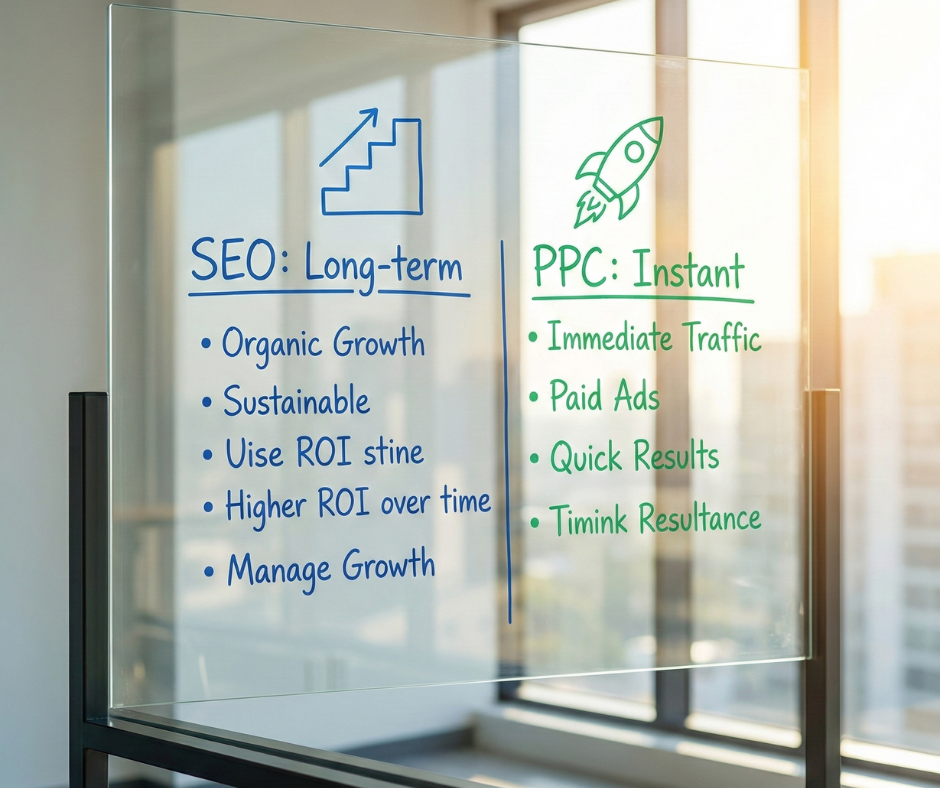
SEO vs. PPC for Magento Key differences at a glance
To help visualize the strategic trade-offs, consider the following differences in how each channel functions within the Magento ecosystem:
| Feature | SEO (Organic search) | PPC (Paid advertising) |
| Speed to results | Slow (Months to years) | Instant (Days to weeks) |
| Cost structure | Front-loaded (Investment in labor/tech) | Ongoing (Pay-per-click/impression) |
| Sustainability | High (Traffic persists if you stop spending) | Low (Traffic stops when spend stops) |
| Scalability | Non-linear (Harder to predict exact lift) | Predictable (More spend usually equals more clicks) |
| Trust level | Higher (Organic results are often more trusted) | Lower (Marked as “Sponsored”) |
| Magento complexity | High (Requires technical expertise) | Medium (Requires feed management) |
Pros and cons of SEO for Magento stores
Advantages of SEO
The most significant advantage of SEO is the compounding nature of organic traffic. Every well-optimized category page and high-quality blog post you create acts as a long-term asset. Over time, your cost per acquisition (CPA) decreases because you are no longer paying for every individual click. Once you rank, the traffic is essentially “free,” allowing for higher profit margins.
Furthermore, Magento’s architecture is naturally built for SEO. Its category-driven structure allows you to build massive topical authority in specific niches. For example, a Magento store selling automotive parts can create thousands of optimized landing pages for specific makes and models. This builds brand trust; when a user consistently finds your store at the top of organic results, your brand is perceived as an industry leader.
Limitations of SEO
SEO is not without its hurdles, especially on Magento. The technical complexity is high. Out-of-the-box Magento can be slow and bloated, requiring specialized developers or high-performance themes (like Hyvä) to optimize performance. Furthermore, you are at the mercy of Google’s algorithm updates. A single update can shift rankings overnight, requiring constant vigilance. Because results take a long time to materialize, it is difficult to use SEO for short-term goals, such as clearing seasonal inventory or launching a new product line.
Pros and cons of PPC for Magento stores
Advantages of PPC
PPC offers the “light switch” effect: you turn it on, and traffic appears almost instantly. This is invaluable for new Magento stores that have yet to build organic authority. PPC allows for surgical precision; you can target users based on their exact location, the device they are using, the time of day, and even their browsing history.
PPC is also the ultimate testing ground. Want to know if a $50 price point works better than $45? Run an A/B test with paid ads and get your answer in a week. This data-driven approach is essential for high-growth Magento stores that need to make quick decisions about product-market fit or promotional effectiveness.
Limitations of PPC
The primary limitation is the “pay-to-play” model. The moment you stop the budget, the traffic vanishes. In many Magento niches, the cost-per-click (CPC) is rising as more competitors enter the auction, which can squeeze profit margins if the conversion rate isn’t optimized. Additionally, managing product feeds for thousands of Magento SKUs can be technically demanding, requiring regular maintenance to prevent ad disapprovals in Google Merchant Center due to data mismatches.
SEO vs PPC: Which is better growth strategy for Magento
When you should focus to SEO strategy
SEO should be your primary focus if you are in it for the long haul and have the patience to build a sustainable asset. Brands that have established themselves and have a healthy cash flow to invest in long-term equity should prioritize organic search.
SEO is particularly effective for:
- Large catalogs: If you have 50,000 SKUs, paying for a click on every single one is financially impossible. SEO allows you to capture long-tail traffic across your entire catalog through category and product page optimization.
- High-authority niches: If your products require education (e.g., medical supplies or complex machinery), SEO-driven content like guides and “how-to” articles will attract buyers during the research phase.
- Low-margin products: If your margins are thin, the ongoing cost of PPC may result in a negative ROI. SEO helps lower your blended CPA over time, making low-margin products more viable.
When to focus PPC strategy
PPC is the superior choice for stores that need immediate results or have specific, time-bound objectives.
PPC is the go-to strategy for:
- New store launches: If you just migrated to Magento or launched a new brand, SEO won’t provide meaningful volume for months. PPC gets you your first customers and provides immediate data.
- Flash sales and holidays: Black Friday and Cyber Monday are won on PPC. You cannot wait for SEO to rank your holiday-specific landing pages; you must buy your way to the top of the search results.
- High-margin items: If you sell high-ticket items with a large profit margin, you can afford a higher CPC because a single conversion justifies the spend.
- Market testing: Use PPC to see which categories or product types have the highest demand before committing to a six-month SEO content strategy for those areas.
SEO vs. PPC for Magento: Cost, ROI, and timeline comparison
The financial models for these two channels are fundamentally different, and understanding this is key to budgeting.
- Investment: SEO is an upfront investment in labor (developers, writers, strategists). PPC is a variable expense that scales directly with traffic volume.
- Timeline to ROI: * SEO: Usually shows a negative ROI for the first 4-6 months, turning positive and then growing exponentially after month 12.
- PPC: Should show a positive ROI within days or weeks of campaign launch, provided the conversion rate is healthy.
- Measurement: PPC success is measured by Return on Ad Spend (ROAS). SEO success is measured by organic traffic growth, keyword rankings, and Customer Lifetime Value (LTV), as organic customers tend to exhibit higher brand loyalty over time.
Why the best Magento growth strategy often combines SEO and PPC
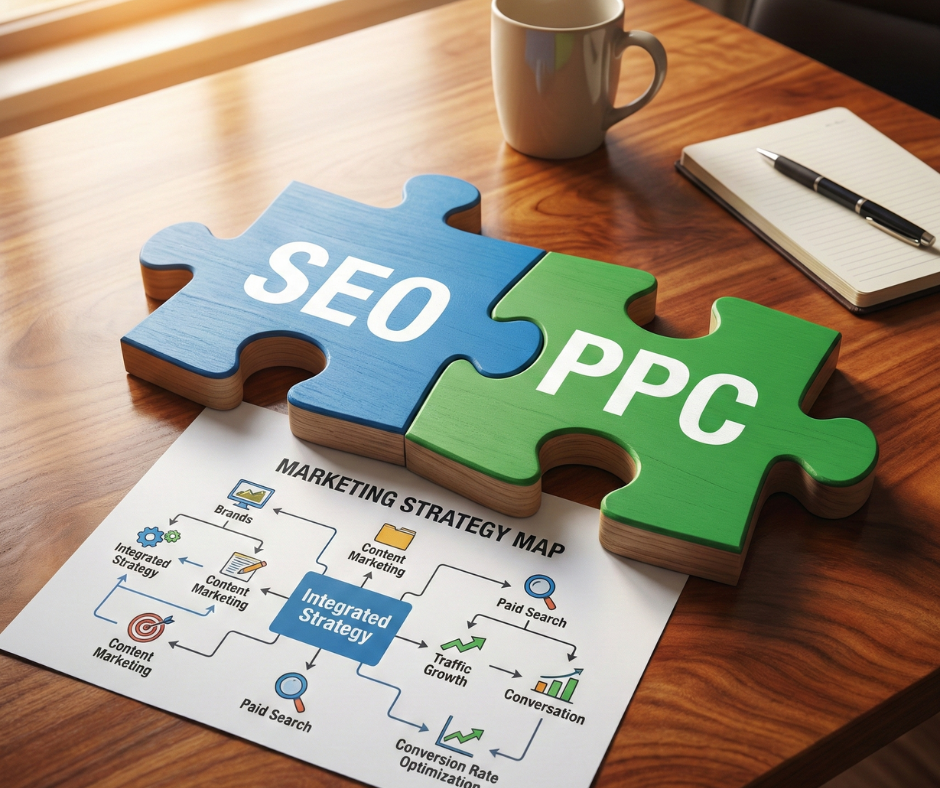
Why the best Magento growth strategy often combines SEO and PPC
In a vacuum, comparing SEO and PPC is useful, but in practice, the most successful Magento stores use a hybrid approach. The two channels are not mutually exclusive; they are complementary parts of a holistic digital strategy.
- Using PPC data for SEO: Your Google Ads reports show exactly which keywords lead to sales. You can take this “winning” list and prioritize those terms for your SEO content strategy to capture that traffic without paying for every click.
- Improving PPC Quality Score with SEO: A well-optimized SEO page is faster and more relevant. Google rewards this with a higher “Quality Score” in your PPC campaigns, which actually lowers your cost per click and improves ad placement.
- The “billboard” effect: When a user sees your paid ad at the top of the page and your organic listing right below it, your brand is perceived as the dominant authority. This significantly increases the overall click-through rate for your store.
- Remarketing: You can use SEO to bring in “cheap” top-of-funnel traffic through blog posts and then use PPC remarketing to follow those visitors and close the sale when they are ready to buy.
How to choose the right strategy for your Magento store
Key factors to consider
- Business stage: New stores need PPC for survival. Established stores need SEO to protect their margins and build long-term defense.
- Budget and cash flow: If you need money in the bank tomorrow to pay for inventory, go with PPC. If you can afford to wait for a bigger payout in a year, invest in SEO.
- Competitive landscape: Research your competitors. If they are all bidding heavily on your primary keywords, PPC will be expensive, and a “content-first” SEO strategy might be your backdoor into the market.
- Internal resources: Do you have a great writer or developer? Focus on SEO. To accurately assess your site’s readiness for an organic push, utilizing a detailed Magento SEO checklist can reveal the technical gaps that might be hindering your current visibility. Do you have a data-driven analyst? Focus on PPC.
Evaluating SEO vs. PPC for Magento: choosing the best approach for your online store
- If you are launching a new Magento store with a healthy margin, then start with 80% PPC and 20% Technical SEO to build immediate revenue while setting the foundation.
- If you are an established store with high ad costs, then shift toward 60% SEO and 40% PPC, focusing paid spend on remarketing and top-tier product launches.
- If you are in a niche with massive search volume and low competition, then go 100% SEO to capture the market before the competition drives up ad costs.
- If you have seasonal products, then use a flexible PPC budget that scales up during peak times while maintaining a steady SEO presence year-round.
Common mistakes Magento stores make include treating SEO as a one-time project rather than a continuous process, or relying solely on PPC without optimizing the store’s conversion rate, leading to “leaky bucket” syndrome.
Final thoughts
Ultimately, understanding SEO vs. PPC for Magento: choosing the best approach for your online store is about balancing short-term acceleration with long-term stability. There is no one-size-fits-all answer; the optimal mix depends on your current business reality, your growth ambitions, and your tolerance for risk.
SEO builds the foundation of your digital estate. It is an investment in your brand’s future and a way to ensure that your store remains profitable in the long term. PPC is the accelerator; it provides the fuel needed to move fast, test ideas, and generate immediate cash flow.
Before making a decision, audit your current Magento performance. Look at your site speed, your conversion rate, and your competitors’ visibility. Align your strategy with your timeline and budget, and remember: the most resilient eCommerce businesses are those that do not rely on a single source of traffic. By carefully weighing SEO vs. PPC for Magento: choosing the best approach for your online store, you create a diversified, scalable growth engine that can withstand market shifts and drive sustained success.