Managing SEO metadata in Magento 2 becomes increasingly complex as your product catalog grows. While meta keywords are no longer a ranking factor for Google, they have not disappeared from Magento, and they are still actively used by many stores for internal and operational purposes.
Understanding when Magento meta keywords are useful, when they are not, and how to manage them efficiently helps merchants avoid outdated SEO practices while keeping their backend clean, scalable, and consistent.
Nội dung bài viết
Magento meta keywords: What they are and why they still matter
Magento meta keywords are keyword phrases stored in a page’s HTML metadata to describe its content. In the early days of SEO, search engines relied heavily on this field to determine a page’s topic and relevance.
Today, major search engines like Google ignore meta keywords as a ranking factor due to widespread abuse in the past. However, their removal from search algorithms does not mean the field has no remaining value inside Magento.
In modern Magento stores, meta keywords no longer serve search engines directly. Instead, they function as internal metadata when used alongside SEO-critical elements such as meta titles, meta descriptions, headings, and rich snippets, which provide structured data signals that search engines actually use to enhance search results.
Meta keywords can still be useful in specific Magento-related scenarios where the goal is not external SEO, but internal efficiency and consistency.
Common use cases include:
- Supporting internal search logic: Some custom internal search implementations or third-party search tools use meta keywords as an additional relevance signal.
- Improving catalog organization: Meta keywords can act as structured labels to group similar products or categories internally, especially in large catalogs.
- Maintaining consistency in SEO workflows: For teams managing metadata at scale, meta keywords can help reinforce topic focus and naming conventions across products and categories.
- Ensuring compatibility with legacy systems: Older Magento setups or integrations may still reference meta keywords for data mapping or internal processing.
- Serving as input for automation rules: Meta keywords can be generated dynamically and reused in templates, reports, or custom logic without relying on manual tagging.
Used correctly, meta keywords become internal metadata, not an SEO shortcut.
How to manage meta keywords in Magento 2 efficiently
The real challenge for merchants is not whether meta keywords matter, but how to manage them without creating unnecessary manual work or SEO confusion.
Setting meta keywords manually for Magento 2 products and categories
Magento allows meta keywords to be set for specific content types, each representing a different page type on the storefront.
You can find and set up the meta keywords field in the following areas:
- Product pages
- Navigate to: Admin → Catalog → Products
- Open a product and locate the Search Engine Optimization section
- The meta keywords entered here apply only to that product’s URL
- Category pages
- Navigate to: Admin → Catalog → Categories
- Select a category and open the Search Engine Optimization tab
- Meta keywords affect the category listing page
- CMS pages
- Navigate to: Admin → Content → Pages
- Edit a CMS page and scroll to the Search Engine Optimization section
- Meta keywords apply to standalone content pages such as “About Us” or “FAQ.”
At this level, Magento does not enforce validation, automation, or inheritance for meta keywords. Their presence depends entirely on manual input by the merchant or content team.
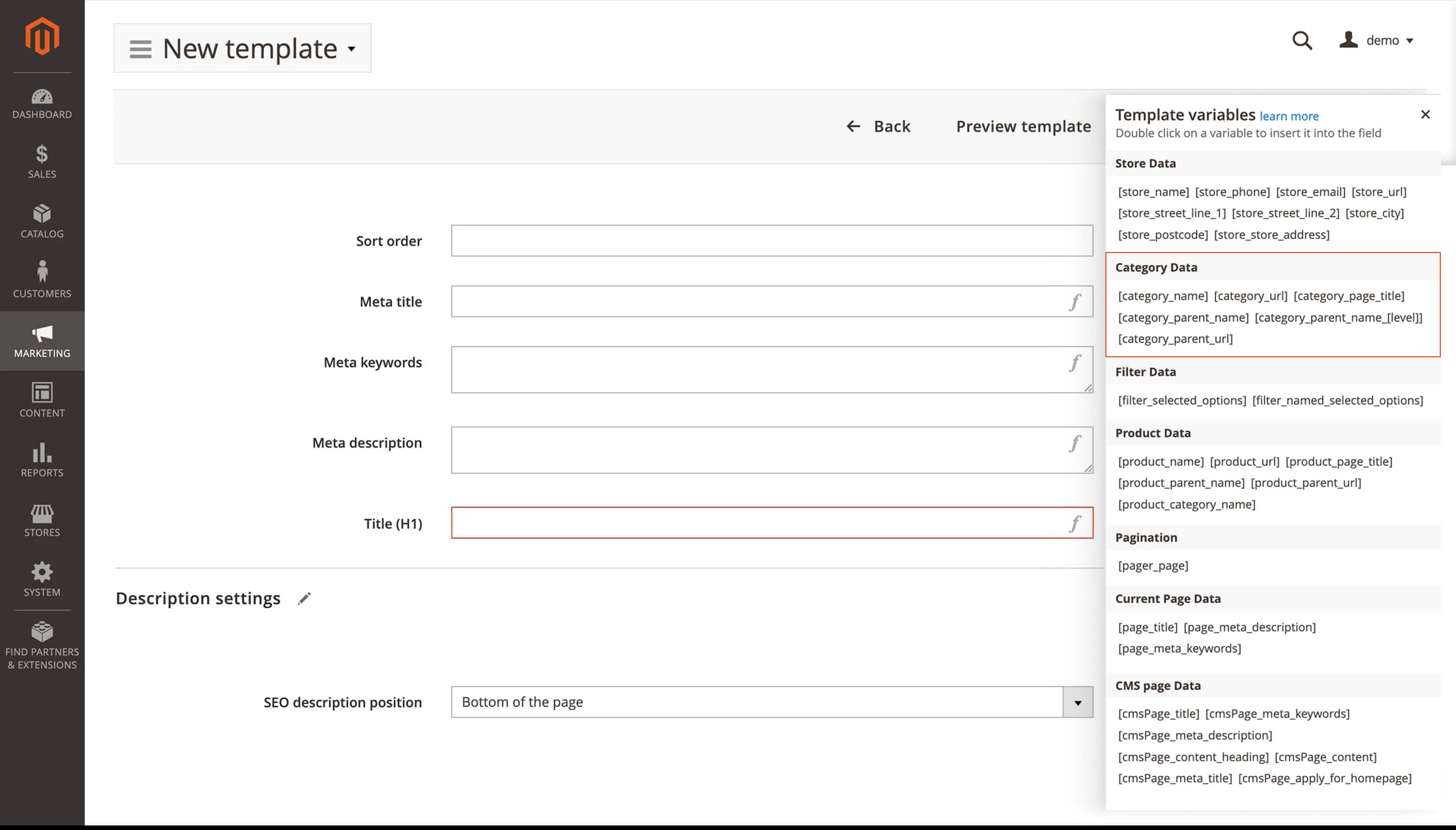
Automating meta keywords with templates
SEO templates allow you to generate metadata automatically based on rules and variables. Instead of editing each product or category manually, templates apply consistent logic across groups of pages.
Key reasons to automate metadata
- Operational efficiency – eliminate repetitive manual work
- Reduced human error – avoid missing fields, duplicates, or formatting issues
- Faster updates – adjust metadata sitewide in minutes
- Improved consistency – ensure uniform structure across your catalog
- Better click performance – clean metadata produces clearer search snippets
Automation is not just a time saver—it’s essential for maintaining SEO quality at scale.
- Automating meta keywords for products and categories
A template-based approach helps generate meta keywords consistently using existing data.
Common template components include:
- Product name
- Primary category
- Brand or manufacturer
- Key attribute (size, material, type)
Example structure:
- Meta Title: [product_name] – Buy at [store_name] | [category_name]
- Meta Description: Buy [product_name] in [category_name] at [store_name]. Fast delivery and competitive prices.
- Meta Keywords: [product_name], [category_name], [product_brand]
- H1: [product_name] – [store_name]
Benefits of template-based automation:
- Reduces manual data entry
- Ensures consistent formatting
- Makes bulk updates easier
- Keeps metadata aligned with catalog changes
This approach treats meta keywords as derived data, not manually written SEO content.
- Automating meta keywords for layered navigation
Layered navigation pages often generate multiple URL variations based on filters, making manual metadata management impractical.
In advanced Magento setups, meta keywords can be:
- Generated dynamically from selected filter attributes
- Used internally to support filtered search logic
- Excluded from SEO-critical pages to avoid duplication
For example:
- Category + color + material filters can feed internal metadata logic
- SEO impact remains neutral, while internal consistency improves
Automation here focuses on internal usability, not ranking signals.
Best practices if you choose to use meta keywords
If your Magento store still uses meta keywords for internal workflows, they should be treated as structured metadata, not as an SEO tactic. The goal is to keep usage predictable, consistent, and easy to maintain as the catalog grows.
Keep meta keywords short and structured
Meta keywords work best when they act as clear internal labels rather than SEO signals. Long keyword lists or loosely structured phrases reduce clarity, increase maintenance effort, and make automation harder to control.
How to do
- Limit meta keywords to a small set of highly relevant terms that reflect the main topic of the product or category.
- Use a fixed and predictable order, such as product name followed by category or brand, to keep metadata consistent across similar pages.
- Avoid repeating the same word in multiple variations and keep formatting simple by separating keywords with commas only.
Align meta keywords with internal search and catalog logic
Meta keywords only provide value when they support an existing internal process, such as search relevance, catalog grouping, or reporting logic.
How to do
- Identify where meta keywords are actually used, for example in custom internal search logic or third-party search extensions.
- Choose keyword terms that match how products are grouped and searched inside the store, not how Google ranks pages.
- Remove or avoid keywords that are not referenced by any internal feature or workflow.
Maintain consistency across store views and languages
In multi-store or multi-language Magento setups, inconsistent meta keyword usage can break automation rules and create confusion for content teams.
How to do
- Decide upfront whether meta keywords should be translated per store view or kept standardized across all views.
- Apply the same keyword structure across languages, even when the terms themselves are translated.
- Avoid mixing multiple languages within the same store view to keep metadata clean and predictable.
Document internal rules for content and SEO teams
Without clear documentation, meta keywords often become inconsistent as multiple team members manage products and categories over time.
How to do
- Create a simple internal guideline explaining when meta keywords should be used and when they should be left empty.
- Include clear examples for products and categories to avoid subjective interpretation.
- Clarify that meta keywords do not affect Google rankings and exist only for internal or operational purposes.
Common mistakes with Magento meta keywords
Even though meta keywords no longer influence search rankings, they are still frequently misused in Magento stores. These mistakes often come from outdated SEO practices or misunderstandings about how modern search engines evaluate page relevance.
- Treating meta keywords as a ranking factor: Some store owners still expect meta keywords to improve visibility in search results. In reality, search engines like Google ignore this tag entirely, so relying on it leads to wasted effort and missed optimization opportunities elsewhere.
- Auto-generating sitewide keywords: Applying the same set of meta keywords to every product, category, or CMS page creates duplication and signals low-quality metadata management. This approach offers no SEO benefit and reduces page-level relevance.
- Using competitor or irrelevant terms: Adding competitor brand names or keywords unrelated to the page content may seem like a shortcut to capture traffic, but it weakens semantic relevance and can cause compliance or trust issues.
- Ignoring content quality: Focusing on meta keywords instead of improving meta titles, meta descriptions, and on-page content results in poor alignment with search intent and weaker overall SEO performance. Instead of overusing meta keywords, merchants should prioritize content quality and product page UX elements that boost SEO, which directly affect user behavior and search performance in Magento stores.
FAQs
Is Magento 2 SEO friendly?
Yes. Magento 2 offers strong built-in SEO capabilities, including metadata management, canonical URLs, sitemaps, redirects, and structured data support.
Do meta keywords still matter in 2025?
They no longer affect Google rankings, but they can still help with internal search, catalog organization, and certain integrations.
Should I automate meta keywords or manage them manually?
Automation is recommended for large catalogs. Manual editing is only practical for a small number of high-value pages.
Can meta keywords improve internal search results?
Yes. When configured properly, they can help Magento’s internal search match products with alternative terms.
What’s the biggest mistake with Magento SEO templates?
Incorrect priority settings or allowing existing metadata to override templates, which makes it seem like templates aren’t working.
Conclusion
Managing Magento metadata manually doesn’t scale. By using SEO templates and automation, you can maintain consistent, accurate metadata across thousands of pages with minimal effort. While meta keywords no longer influence external rankings, they still support internal search, organization, and operational clarity. When combined with strong titles, descriptions, and structured data, automated metadata becomes a practical advantage—not just an SEO task.